
Treating water during a drought
The United States is in the midst of a worsening drought, following the warmest winter on record, causing a potential threat to individuals, agriculture and industry throughout the country, according to the National Weather Service. The current drought has officials worried about drinking water quality.
By Jim Gamlen, vice president and technical director, Garratt-Callahan Company
Table of Contents
Water treatment program goals
Water quality varies dramatically from one place to another
Application expertise is key to success
Understanding scale and deposition
Corrosion in cooling systems
Cooling system fouling
Controlling biological growth with chemicals
Fouling control with filters
Proper cooling tower maintenance
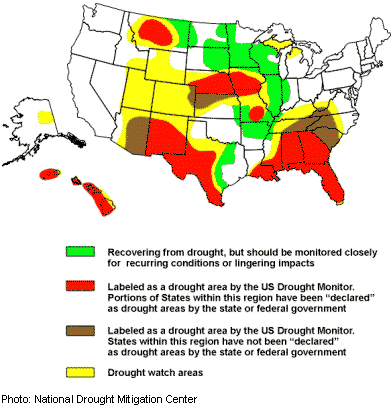
Areas in the United States projected to be the hardest hit in this year's drought will be Arizona, New Mexico, Texas, Louisiana, Mississippi, Arkansas, Alabama, Tennessee, Florida, and Georgia. Those areas impacted by the drought of 2000, according to the national Oceanic and Atmospheric Administration, parallel those affected by the drought of 1988, which was the most costly weather disaster in history. This has officials worried about drinking water quality.
Drought greatly affects water treatment programs already implemented. It is well known that seasonal changes produce a variance in water quality. Many areas rely on lakes for their major supply of water. In hot weather, when water evaporates from the lakes, suspended and dissolved solids concentrate in the water, potentially requiring more chemical use for the proper quality of water necessary for industrial and commercial purposes. As water levels drop, increased sediment and dissolved solids as well as bacteria, algae blooms and other microorganisms decrease the quality of drinking water supplies and process cooling make-up water.
Water is not an unlimited natural resource. High-water-use industries must be prepared not only to pay much higher prices for lower quality water, but also to do more with less. New water-use programs should be planned to accommodate the restrictions on how much water can be used in a given period of time. Proper water treatment planning and program design can help make this change easier.
Water has been 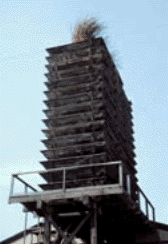 used as a heat transfer medium for many years. When water, fuels and discharge costs were inexpensive, the use of these resources was not regulated. Costs have risen, and the need for a more efficient approach to resource management is in demand.
There are three basic areas that are critical in developing an effective water treatment program: corrosion/scale tendencies, water quality variance, and water availability.
Water treatment program goals
The primary goals of any water treatment program are to prevent the development of corrosion, scale and microorganisms in order to assure a safe working environment, reduce energy and water use, preserve valuable assets and reduce labor costs. All water exhibits either a corrosive or scaling tendency with varying degrees of severity. Some types and sources of water are of better quality than others, however perfectly stable water does not exist. (Return to Table of Contents)
Water quality varies dramatically from one place to another
Water quality, the types and concentrations of impurities, can vary dramatically from one location to another. The selection of a particular formulation and the amount of chemical used are directly related to the quality of water used at that site. Even within a relatively small geographic area, the variance in water quality can require a tailored water treatment program for each particular site. This is especially true during a drought. Different sources of water (well and river, for example) could be in use which displays variances in hardness, alkalinity, and other factors. If the operators do not make adjustments daily, serious consequences could arise. (Return to Table of Contents)
Application expertise is key to success
It is essential that the correct water treatment chemicals, product concentrations and field service be purchased for the plant, but of greater importance is application expertise, laboratory support, research and development, and the technical support behind those products. In a cooling water system, water is used as a heat transfer medium. Although temperatures in the cooling process are not high, cooling systems involve the removal of heat from water and are continually saturated with oxygen, creating the perfect environment for corrosion. A small amount of scale can shut down a cooling system.
The tower makeup 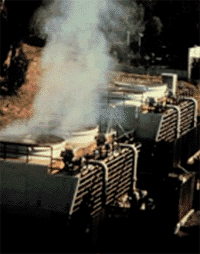 water contains suspended particles consisting of metal oxides, decaying organic matter, dirt, and minerals that are concentrated during the evaporative cooling process. Some of this material becomes nutrients for the growth of algae and bacteria. Deposit control mechanisms include the use of dispersants, surfactants, precipitants, filtration, and proper maintenance.
In an open re-circulating cooling tower system, water is continuously re-circulated and open to the air. Water moving through a heat source (condenser, chiller, evaporator, etc.) increases in temperature and is then cooled by evaporation in the tower. Makeup water must be continuously added to compensate for evaporation, leaks and blowdown. When the quality of make-up water is poor to begin with, as in a drought, the level of contaminants is higher than normal and needs to be re-assessed. Air is passing continuously through a cooling tower and this introduces a variety of gasses including additional oxygen and environmental debris into the system. The open re-circulating cooling tower system has the greatest potential for problems associated with deposits, corrosion, and microbiological growth for the following reasons:
- Higher water temperatures
- Introduction of environmental debris
- Continuous makeup
- Continuous high levels of oxygen
Once-through systems pass water through heat exchange equipment (or other operating equipment) and then the water is discharged. These systems need large quantities of low cost, low temperature water; typical water sources include lakes, rivers and wells.
Since the water comes from a variety of environments, problems to be aware of include: pitting, corrosion, flow restriction, scale buildup, sediment buildup, heat transfer loss, iron transport, and product contamination. In a closed re-circulating system, corrosion and scale control are simplified if the system is running in a normal and healthy condition with very little makeup water. Little, if any, evaporation should take place, and without evaporation, scale is not normally an issue. Drought situations require more attentiveness. (Return to Table of Contents)
Understanding scale and deposition
The term scale refers to the deposits produced by the crystallization or precipitation of salts from solution. Scale on a heat-exchanger surface presents the most serious interference in heat transfer through that surface. Basic conditions for scaling are met in areas of the system that have the highest water temperature, or when the water simply becomes over-saturated with silica or any other scale forming compounds.
There are three standard methods for preventing formation of scale:
- The removal of scaling minerals from the water prior to use.
- Inhibit the precipitation of scaling compounds.
- Allowing the impurities to precipitate as a removable sludge rather than as a hard deposit
Within a system having soft water and low alkalinity, controlling the tower bleed rate is an effective means for keeping dissolved solids in solution. However, in systems with hard water and high alkaline conditions, inhibitors are needed in order to control scale. Inhibitors control scale through threshold inhibition, dispersion, and crystal modification. Threshold inhibition is when inhibitors are used to keep highly concentrated solutions from precipitating into scale forming compounds. Dispersants prevent the formation of scale forming compounds by manipulating their affinity and keeping them suspended in solution. Crystal modification allows both the formation and precipitation of scale forming compounds, but modifies the compound structure so it produces a sludge that is managed through blowdown or by filtration. (Return to Table of Contents)
Corrosion in cooling systems
"Corrosion" in cooling systems, is the actual loss of metal through one or more of a variety of mechanisms, and can cause the premature failure of the system, resulting in down time and the need for replacement cooling equipment. Deposition of corrosion products on heat exchanger surfaces also decreases the efficiency of the system by decreasing the flow rate and hindering heat transfer. (Return to Table of Contents)
Cooling system fouling
Fouling is the deposition of inorganic or organic solids suspended in the cooling water. Suspended solids, biological growths and makeup water contaminants, can gather in any areas of the cooling system where there is a blockage to fluid flow or any decrease in the normal fluid flow velocity. As air passes through a tower, the water absorbs dirt, silt, and microorganisms from the air. The warm and humid environment in the tower is ideal for biological growths such as algae, fungi, and bacteria, whose colonies produce the biological slimes that can badly foul heat exchangers. Slimes can occur throughout the whole recirculating system and may not be visible. Throughout interior portions of the system, slimes and deposits can decrease efficiency in heat transfer or plug tubes. Excessive fungal growth may penetrate the timbers in towers, digesting the wood and ultimately causing collapse of the tower. (Return to Table of Contents)
Controlling biological growth with chemicals
Chemical treatment is a reliable method of biofouling control, and its effectiveness against microorganisms is well established. A biocide supplement can be added to open, closed or once-through systems as a preventive measure. The loss of corrosion inhibitors due to system leakage or biological organisms in the system can increase the cost of maintaining proper chemical residuals, as well as increasing potential for corrosion and deposition problems.
Biocides are added to cooling tower, process and chilled water systems to prevent three potential problems, which stem from biological growth. All three result in higher operating costs.
Biological growth will:
- Impede heat transfer in the system, resulting in energy loss.
- Cause destruction of structural materials.
- Create an environment conducive to diseases and personnel hazards.
Biological problems should be handled correctly to produce clean systems. Good housekeeping of the tower system is important for an effective biocide program. Especially when water conservation is implemented in cooling systems, an excessive buildup of dirt and debris will absorb the biocides, making them ineffective at the dosage levels allowed.
To prevent these problems and uncontrolled growths, the following areas should be addressed:
- The proper biocide must be selected for the specific operation. Considerations are tower size, location, water quality, and load.
- All towers should be cleaned at least twice per year and some require even more frequent cleanings.
- Top distribution pans should be covered. Algae require light for photosynthesis, so simply covering these pans can reduce biocide demand.
- The biocide should be added at the proper time of the day. If the operation is comfort cooling, biocide feed at night during low load periods will allow longer retention and a better kill. (Return to Table of Contents)
Fouling control with filters
Filters are widely used in cooling waters for fouling control. In open recirculating systems, filtering a portion of the recirculating water is called side-stream filtering and is effective in removing foulants. Passing only 5–15% of the circulating water through a side-stream filter each day can be effective, although a much higher volume is recommended. (Return to Table of Contents)
Proper cooling tower maintenance
Proper cooling tower maintenance is important, because towers are open and they will wash large amounts of dirt and debris out of the air. Typical environmental debris in towers includes sand, insect bodies, clothing fibers paper, leaves, grease, pollen, and more. These materials cannot be dissolved chemically and trying to do so will harm the tower. Chemical treatment may be able to help keep these materials from adhering to heat transfer surfaces, but they will eventually accumulate in the basin, sump, or in low-flow areas of the system. Dirt and debris will accelerate corrosion, scale, and biological growth. All towers should be manually cleaned whenever noticeable debris accumulates in the basin. Even if the tower basin remains clean, all towers should be shut down and undergo complete cleaning and inspection at least once per year in order to insure that the interior is properly maintained. Realistically, many towers require such service two to four times a year, as well as having condensers opened, inspected, and cleaned of deposits and debris.
With the climactic variances in many regions of the country becoming more frequent, it is imperative that water treatment systems already in place, be re-analyzed for effectiveness under the new conditions. By monitoring and making simple adjustments, most detrimental effects will not be experienced and costly corrective measures won't be necessary. Reduction of water use, mandated in many drought situations, can also be achieved in spite of decreases water quality if a technically sound water treatment program is planned and properly implemented. (Return to Table of Contents)
About the author: Jim Gamlen is vice president and technical director of Garratt-Callahan Company, provider of water treatment chemicals for nearly a century. For more information, contact the company at 650-697-5811. (Back to top)
Edited by Tracy Fabre
Managing Editor, Water Online