
Eastside Reservoir project receives Outstanding Civil Engineering Achievement Award
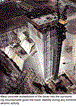
The largest earth-and rock-filled reservoir in the U.S. boasts $100 million worth of topnotch recreational facilities.
Recreation planning and environmental preservation are the dual assets that won the Eastside Reservoir Project of Riverside County, California, an Outstanding Civil Engineering Achievement Award of Merit from the American Society of Civil Engineers this year.
The prestigious award was presented to the owner of the project, the Metropolitan Water District of Southern California.
Provides state-of-the-art facilities
"The Eastside Reservoir Project is commendable not just because it provides state-of-the-art water supply and recreational facilities for so many Californians, but because it demonstrates that engineering ingenuity and problem-solving skills are being used to do something positive for the environment," said ASCE President Delon Hampton, Ph.D., P.E.
Early this year, the Metropolitan Water District of Southern California began filling the Eastside Reservoir Project, which is the largest U.S. earth-and rock-filled reservoir at 4.5 miles long and 2 miles wide. The water in the reservoir will be 250 feet deep and amount to 800,000-acre-feet.

When completed, the $2.1 billion project will provide a dependable, high-quality water supply to 6% of the U.S. population (16 million people) to meet emergency, drought and seasonal needs.
Expected to be mecca for sports enthusiasts
With $100 million worth of recreational facilities, including marinas, campgrounds, golf courses and bike trails, the project will be a mecca for sports enthusiasts. It creates diverse recreational opportunities in a region where aging and inadequate parks are no longer meeting the modern demands of a demographically diverse population.
Specifically, the project includes an Olympic-size pool, nearly 500 campsites, slips for more than 250 boats and 80 miles of hiking and biking trails. The project also features two man-made lakes in addition to the reservoir.
Environmental protection major goal
In addition to providing a source of drinking water and recreational activities, environmental protection was also a major objective for the MWD. The project features a 9,000-acre wildlife reserve, enabling the preservation and management of eight types of habitats and more than 15 sensitive wildlife species, such as the Stephens' kangaroo rat and the bald eagle.
The enormity of the project can be reflected in the 270-foot-tall inlet/outlet tower, a 16-foot-diameter pressure tunnel, a pumping plant that houses 12 6,032-horsepower vertical turbine pumps, a 500-acre-foot forebay, a new 9-mile-long, 12-foot diameter steel pipeline, a secondary inlet, and numerous large-diameter valves.
Seventh largest dam project in world
The total embankment volume is 114 million cubic yards—the seventh largest dam embankment project worldwide. Workers hauled and placed more than 150 million cubic yards of material—more than two times the total excavation of the "Chunnel" project linking England and France.
Almost all material mined in valley
Except for the cement, all material was mined from inside the reservoir boundary. The impervious center zone of each dam's embankment came from alluvial clayey silts and silty sands excavated from the valley loor and then hauled and compacted with large high-production equipment.
The reservoir is one of the safest civil-engineering projects in the world, say its builders. Substantial field explorations and laboratory testing led to incorporating conservative redundant safety features in the embankment; a cutoff beneath the dams; and sufficient freeboard in the reservoir. The inlet/outlet tower stands within a deep roack cut and is then locked in place with mass concrete between the structure and the three rock faces.
Each year since 1960, OCEA awards have been presented to extraordinary engineering projects for their contribution to community wellbeing, resourcefulness in planning and solving design challenges, and use of innovative construction methods.
Earlier this year, a six-member panel of prominent engineers and journalists, (including Public Works Online Editor Joyce Everhart) selected the reservoir project as one of the winners from among 27 submissions nominated by ASCE district directors from across the U. S.
Reservoir is 18th Califonia project to win prestigious engineering award
The Eastside Reservoir Project is the 18th project in California to receive an OCEA award during the past 40 years. Past OCEA winners California include the Los Vaqueros Project of Concord (OCEA in 1999); the Muni Metro Turnback of San Francisco (Award of Merit, 1998); and the Sacramento Regional Wastewater Management Program (Award of Merit, 1984).
Founded in 1852, ASCE represents more than 123,000 civil engineers worldwide and is America's oldest national engineering society.
By Joyce Everhart
Editor, Public Works Online
Source: American Society of Civil Engineers