
Cape Hatteras Light Station wins still another engineering award for Lawgibb

The moving of an historic lighthouse has won awards from both the American Society of Civil Engineers and the American Consulting Engineers Council for engineering firm-Lawgibb Group.
Lawgibb Group's landmark engineering work on the Cape Hatteras Light Station Relocation Project has been recognized by yet another engineering association.
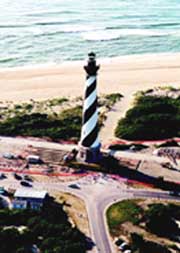
An aerial view shows the enormity of the task of moving the historic lighthouse inland to save it from the ravages of the encroaching ocean.
First, the American Society of Civil Engineers, America's oldest national engineering society, selected the project for its Outstanding Civil Engineering Achievement Award for 2000 (see related story, "Lighthouse moving project wins ASCE outstanding project award").
Of 27 nominated projects, five were selected as finalists, with Cape Hatteras taking the OCEA.
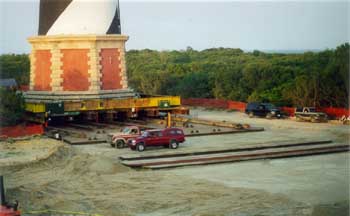
The trucks in the foreground give scale to the size of the lighthouse as it rests on the rails ready to move.
Second, Lawgibb was also honored with the Grand Award – Special Projects Category, for its submittal to the American Consulting Engineers Council. Of 161 state and regional winners, 48 were short listed for further evaluation. Twenty-four garnered awards: 16 honor awards and seven Grand Awards representing the top award nationwide for their respective category.
Lawgibb served as the lead engineering consulting firm for the light station design-build relocation team that comprised 22 technical and engineering disciplines. The Cape Hatteras Light Station Complex is located on North Carolina's Outer Banks and was completed in 1870.
Services provided by LAWGIBB included geotechnical and hazardous materials investigations; geotechnical, structural, materials, instrumentation, and electrical engineering; design and construction management assistance; environmental services; and construction quality control.
Ongoing technical peer review process contributed to success of historic project
Lawgibb also initiated a technical peer review process during the design and construction phases that was instrumental to the project's success and provided quality assurance. The firm's design and preparation of the supporting move corridor was integral to accurately predicting settlements and deflections of the lighthouse during its actual relocation.
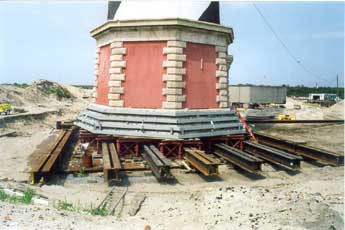
Another view of the beams beneath the structure gives an idea of how the structure was moved.
Key project features and challenges included:
- Removing over 700 tons of original granite foundation.
- Designing/constructing a temporary steel underpinning foundation and transportation system.
- Designing and preparing a move route across loose sand.
- Minimizing the impact of the corridor construction and temporary work lighting on natural resources, including the endangered sea turtle.
- Lifting and moving the 5,000-ton lighthouse and other structures without damage using hydraulic jacking and controls.
- Designing/constructing new foundations.
- Coordinating visitor and press access to this internationally publicized move.
"Besides being an incredible engineering feat, this project spoke volumes about the American spirit," said Francis A. Peltier, National Park Service superintendent of the Cape Hatteras National Seashore. "We have passed on to future generations a window through which they can view the greatness of our national past and come to know who we are as a people and a nation."
Founded in 1946, Law acquired the prestigious firm of Gibb Ltd., based in Reading, England, in 1989 forming Lawgibb Group, headquartered in Atlanta, GA. The company has expanded its scope of operations to include many traditional engineering and scientific disciplines, and today is widely recognized as one of the world's leading engineering, environmental and design consulting services companies. The firm now has more than 3,500 professionals working in over 100 offices around the world with projects in 160 countries worldwide.
Edited by Joyce Everhart Jungclaus
Editor, Public Works Online