
Device assesses road's structure traveling at normal speeds
However, a pavement that exhibits little or no distress may not be structurally adequate to support anticipated traffic.
Conversely, a pavement with a highly distressed surface may be structurally sound, requiring only surface maintenance and renovation.
Therefore, it is advantageous for an agency or municipality to collect information on both the functional and structural condition of its pavement network to provide a complete analysis of pavement maintenance/rehabilitation and funding needs.
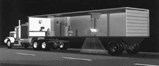
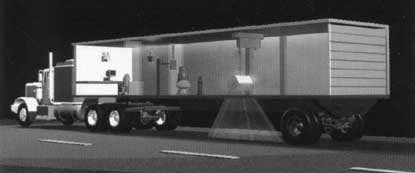
In the ongoing quest to create better data collection and assessment tools, the Federal Highway Administration, working through the Small Business Administration, contracted Applied Research Associates, Inc. to develop a device called the rolling wheel deflectometer which can be applied as a pavement management tool, and will be suitable for network-level analysis of a pavement's structural capacity.
Progressing from a static to a moving load has many advantages
Unlike the falling weight deflectometer, which takes data while stopped at designated test points, the RWD collects data while traveling at normal highway speeds. This allows a very significant increase in the quantity of data that can be collected, and eliminates the safety risks and lane closures that accompany the use of a static instrument.
A number of factors can influence the measurement of pavement deflection under a moving wheel load. These include:
- Wheel load and geometry
- Tire pressure
- Vehicle speed
- Temperature of the pavement surface
The RWD takes into account all of these factors, except for one. Currently, the device does not monitor wheel load variations, but future improvements to the system will add this capability.
Also, because the deflection basin under rolling wheels is not symmetrical, the research team had to determine the best location to collect deflection data. Historically, most data have been collected using the basin behind (trailing) the wheel. However, the RWD uses the basin ahead of (leading) the wheel because it can more easily be compared to the undeflected pavement ahead of the load wheel. Additionally, the leading part of the basin may be less influenced by hysteresis effects.
New technology provides larger laser footprint
The ARA-developed RWD uses a scanning laser system developed by Phoenix Scientific, Inc. The system scans a 14-ft length of pavement in 1 millisecond from a single reference point. This is a significant difference from other rolling wheel deflection systems, both operational and prototype, in which a single sensor only measures the point on the pavement directly beneath the sensor. Advantages of the scanning laser include the following:
- More powerful laser
- Larger laser footprint
- High sampling rate
- Longer standoff distance
- No limitations on measurement distance
- No concern for reference beam alignment
- Measurement of entire deflection basin
- Collection of both deflected and undeflected surface data in one sweep
Two methods developed for data processing
The RWD data processing unit includes software that was developed to provide two approaches to the statistical treatment of the data: low resolution and high resolution. The low-resolution method involves scanning the deflection basin over a specified length of roadway and averaging the results into a single representative deflection basin. Two typical lengths of pavement measured could be 500 ft or 0.25 miles for example. The high-resolution method produces deflection basins at more closely spaced linear increments.
The deflection basin data then can be converted to a structural index that rates the pavement structural capability on a 1 to 10 numerical scale.
Second round of validation tests planned
ARA has completed the first generation RWD, and initial testing on roadways near the firm's Vicksburg, MS, office has demonstrated that the RWD can measure deflection basins under the moving wheel load at speeds up to 55 mph. However, tests at the Ohio test road failed to validate the RWD deflection measurements when they were compared to those produced by linear variable differential transformers (LVDTs) embedded in the test road pavements. Based on these results, further work on the SLS was deemed necessary. A second round of validation tests will be made at the Ohio test road once this work has been completed.
The FHWA also has contracted with ARA to conduct initial RWD demonstrations in two other states following the validation tests in Ohio. The demonstrations will include a test run on a selected highway, data processing capability, and a presentation on the RWD and the test results obtained. It is anticipated that the states selected for the demonstrations will have instrumented pavements so that comparisons can be made between deflection gage data and the RWD measurements.
Editor's Note: For more information about this project, please contact Jim Hall, PhD, at: 601-638-5401, or via e-mail, jhall@ara.com. Hall is the group leader of Applied Associates' office in Vicksburg, MS.
This study is based on an article that appeared in a recent issue of Eye on ERES, a quarterly publication of ERES Consultants, a Champaign, Illinois-based division of ARA.
Edited by Ian Lisk, Editor Emeritus, Public Works Online