
THORNE: Are you counting your traffic as well as you can?

New technologies and methodologies of traffic counting provide new options for local governments as traffic counts grow in importance.
By Jim Thorne, P.E.
Columnist, Public Works Online
 Why public works agencies count
Many public works agencies collect traffic count data as part of their traffic engineering program. Traffic data supports many transportation infrastructure decisions. Traffic counts may be used to evaluate the need for a new traffic control device at an intersection, or they may be necessary for the traffic impact analysis for a proposed development. Some agencies have ongoing traffic monitoring programs that collect traffic counts at hundreds of locations during the year. In addition to volume counts, data may be collected on vehicle classification, average speeds, lane occupancy, or vehicle occupancy.
States count, probably more than anyone
State highway departments collect count data on the roads for which they are responsible. This data is used to monitor the system and evaluate proposed improvements. State DOTs also prepare the Highway Performance Monitoring System submittal to the FHWA. The HPMS collects data related to the national transportation system, including items such as Annual Average Daily Traffic for selected segments, percent trucks, and average speed.
Highway Performance Monitoring System key
The Highway Performance Monitoring System is important because it provides data used to allocate federal funds and measure travel characteristics. A major purpose of the HPMS is to provide data that reflects the extent, condition, performance, use, and operating characteristics of the Nation's highways. The HPMS information is used by FHWA to develop the bi-annual report to Congress on the condition of the highway system. This data source is also used for assessing highway system performance under FHWA's strategic planning process and for apportioning Federal-aid funds under TEA-21. In addition, the HPMS serves needs of the States, MPOs and local government and other customers in assessing highway condition, performance, air quality trends, and future investment requirements.
Metro planning agencies also rely on traffic counts
Many metropolitan planning organizations also have traffic counting programs. Their interest in the data is often for use in validating computerized travel demand forecasting models, traffic studies, and evaluation of proposed improvements. Many MPOs also collect and contribute local data to the HPMS program.
Still others perform traffic counts
Other groups that count are consulting firms that do traffic impact studies for proposed developments, or project development studies for highway improvement projects. Private developers and realtors are interested in the volume of traffic that passes a certain piece of commercial property.
Some of the aforementioned agencies have field crews that do the work, while others contract with private firms to take care of collecting the counts according to their specifications.
Count technology offers a number of options
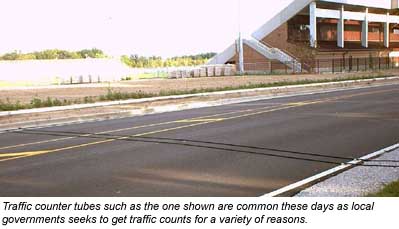
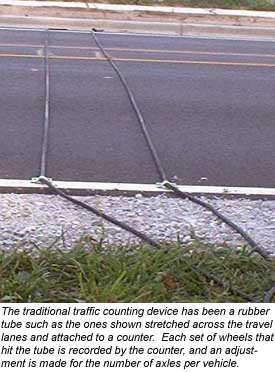
There is a surprising range of options now available for collecting traffic count data. The traditional traffic counting device has been a rubber tube, or tubes, stretched across the travel lanes and attached to a counter. Each set of wheels that hit the tube is recorded by the counter, and an adjustment is made for the number of axles per vehicle. The person sitting by the side of the road (in a safe, inconspicuous location) with a clipboard, or electronic count board is often used for turning movement counts or vehicle occupancy data. But technology has provided a number of great options for collecting good data on the number of vehicles passing a certain point along the roadway. These days, detectors can also tell the speed of the vehicle as well as the vehicle type.
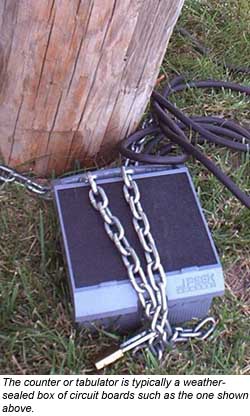
Traffic counters include a detector device that records the presence of a vehicle and a counter or recorder that tabulates the volume. The detector may be a rubber tube, inductive loop detector buried in the ground, a radar beam, a laser, or a person. The counter or tabulator is typically a weather-sealed box of circuit boards or a clipboard with a count sheet to record pencil tick marks.
Methodology is key element of count program
An important element of the count program is the methodology for collecting and handling the count data. This includes methods for selecting count locations, placing equipment, tabulating data, developing and applying axle adjustment factors and seasonal adjustment factors, and quality control procedures. The Traffic Monitoring Guide is a publication prepared by the Federal Highway Administration (FHWA) that is an excellent resource for any agency that does traffic counting. This guide is intended to be a statement of good practice. It contains information on structuring a monitoring program, statistical methods, and a number of related issues.
A prime consideration among all involved in traffic counting is safety. This includes the safety of the crews that install and retrieve the counters, and the safety of the public. Many methods are being developed to avoid placing hardware, and crews in the travel lanes.
FHWA studying non-intrusive counting techniques
The Federal Highway Administration funded a two-year research project that examined non-intrusive traffic detection technologies. Non-intrusive technologies are data collection methods that do not require entry onto the roadway for installation. These methods do not disrupt traffic flow or expose field personnel to dangerous conditions.
Eight different technologies were tested in varying environmental and traffic conditions and at both freeway and intersection locations. These technologies were:
- Passive infrared
- Active infrared
- Magnetic
- Radar
- Doppler microwave
- Pulse ultrasonic
- Passive acoustic
- Video.
The final report for this project, Field Test of Monitoring of Urban Vehicle Operations Using Non-intrusive Technologies was prepared by the Minnesota Department of Transportation and SRF Consulting Group. Following is brief summary of these different technologies:
Passive infrared devices detect the presence of vehicles by comparing the infrared energy naturally emanating from the road surface with the change in energy caused by a passing vehicle. This device detects the difference in heat energy as the means for counting a vehicle.
Active infrared devices detect vehicles by emitting a low energy laser beam at the road surface and measuring the time for the reflected signal to return to the device. A vehicle crossing the path of the detector reduces the time for the signal return.
Passive magnetic devices measure the change in the earth's magnetic flux created when a vehicle passes through a detection zone. Active magnetic devices, such as inductive loops, apply a small electric current to a coil of wires and detect the change in inductance caused by a passing vehicle.
Radar devices use a pulsed, frequency modulate or phase modulated signal to determine the time delay of the return signal.
Doppler microwave devices transmit low energy microwave radiation at a target area on the pavement and then analyze the signal reflected back to the detector. The motion of a vehicle in the detection zone causes a shift in the frequency of the reflected signal. This can be used to detect a vehicle as well as determine the speed.
Pulse devices emit pulses of ultrasonic sound energy and measure the time for the signal to return to the device. Doppler devices emit a continuous signal and use the Doppler principle to measure the shift in the reflected signal.
Passive acoustic devices use an array of microphones aimed at the traffic stream. These devices detect the sound energy of passing vehicles.
Video devices use a microprocessor to analyze the video image input from a video camera.
The final report for this research project discusses the installation methods and the performance of each type of technology as well as the effects of weather, traffic volume, or roadway conditions.
A particularly interesting finding of the study was that, in general the differences in performance from one device to another within the same technology were found to be more significant than the differences from one technology to another. As stated in the report "it is more important to select a well designed and highly reliable product than to narrow a selection to a particular technology."
Managers need to keep abreast of technology
While the technology and methodology for counting traffic continues to evolve, those that spend some part of their typically limited resources to count traffic need to keep abreast of current practices and technology options. This does not mean chasing technology to have the latest gadget. It does imply that a manager reviews data collection needs and procedures and evaluates what available technology can do for them. Is the new device more cost-effective, more accurate, safer for the field crew, safer for the public, or more reliable?
Maybe it is time to review your traffic counting needs, procedures, and technology. An investment in technology may pay off in better count data and a safer environment for field crews and the public.
Resources
NATMEC – North American Travel Monitoring Exhibition and Conference Vehicle Detector Clearinghouse: www.nmsu.edu/~traffic/
FHWA, Office of Highway Policy Information: http://www.fhwa.dot.gov/ohim/